Bone Physiology, Bone Anatomy, Osteoblast, Osteoclast, Cortical Bone, Trabecular Bone
- Types
- Bone
- Anatomy
- See Bone Growth
-
Growth Plate Layers (in the context of other bone regions)
- Articular cartilage of joint
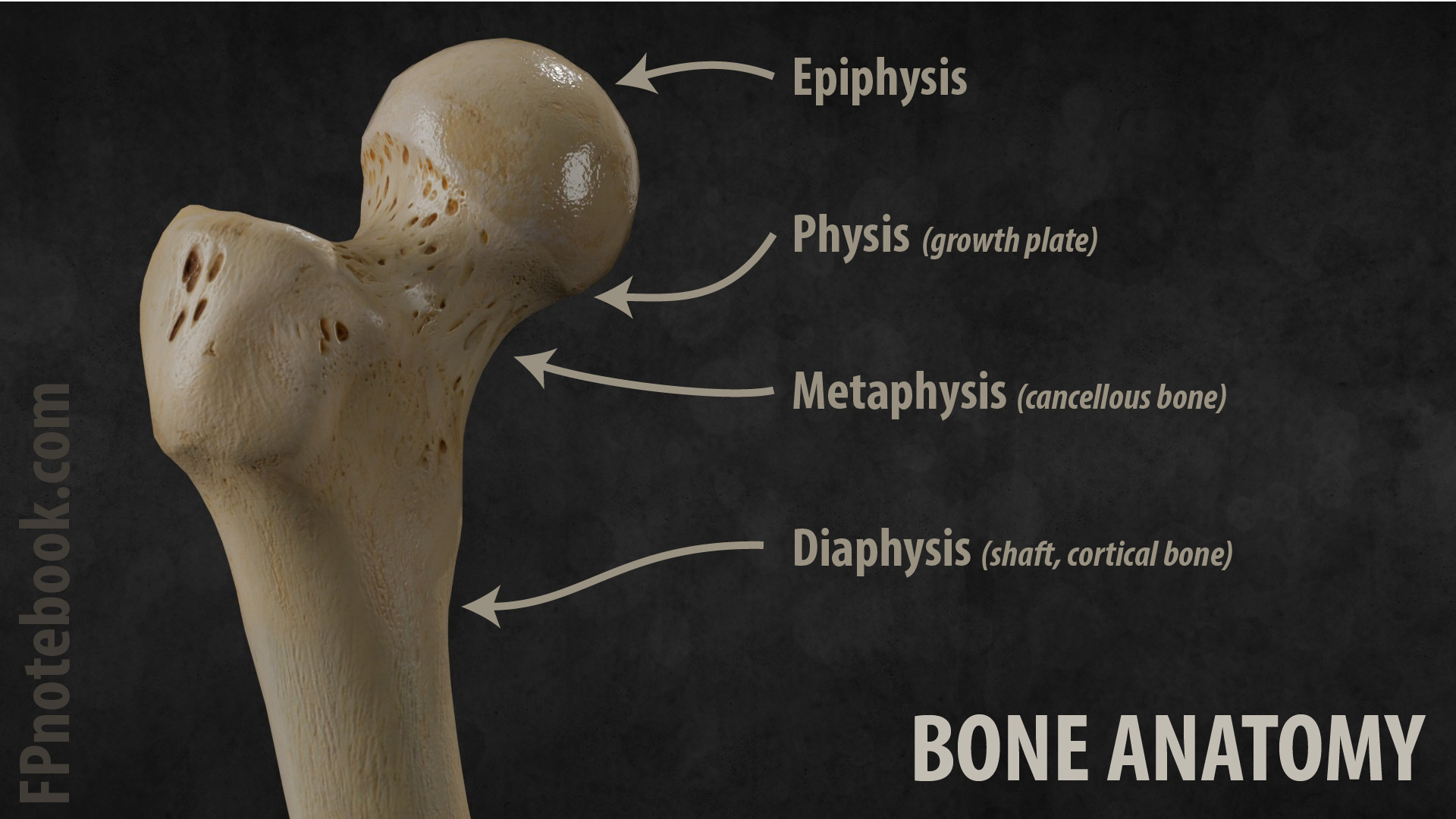
- Epiphysis (rounded bone end)
- Epiphyseal Plate or Growth Plate (Hyaline Cartilage)
- Resting Zone (or Reserve Zone)
- Colloid matrix of vessels and germinal cells (chrondrocyte progenitors)
- Vessels (from the epiphysis) are the primary blood supply to the Growth Plate
- Chondrocytes differentiate from germinal cells, and remain in a resting state
- Proliferating Zone (or proliferative zone)
- Chondrocytes (formed in the reserve zone) undergo Mitosis after migrating to proliferating zone
- Chondrocyte organize into columns of a proteoglycan matrix
- Hypertrophic Zone
- Maturation Zone
- Chondrocytes further differentiate and increase in size throughout the Hypertrophic Zone
- Chrondrocytes also produce Collagen, glycogen, lipids and Alkaline Phosphatase
- Degenerative Zone
- Provisional Calcification Zone (or calcified zone)
- Maturation Zone
- Resting Zone (or Reserve Zone)
- Metaphysis
- Primary Spongiosa
- Secondary Spongiosa
- Diaphysis
- Images
- Physiology
- Bone Growth and Resorption
- Microfractures occur via everyday wear and tear
- Healed by ongoing bone remodeling
- Bone Remodeling
- Bone remodeling occurs in 120 day cycles
- Resorption by Osteoclasts over first 20 days
- Bone formation by Osteoblasts over last 100 days
- Osteoblasts
- Fill in bony cavity with bone matrix
- Triggers for activity
- Parathyroid Hormone
- Thyroxine
- Growth factors
- Interleukins (1, 6, 11)
- Insulin-Like Growth Factors
- Transforming Growth factor-B
- Releases Cytokines to attract Osteoclasts
- Osteoclasts
- Release proteases
- Dissolves bone mineral matrix9
- Dissolves Collagen
- Clears away damaged bone
- Releases matrix-bound growth factors
- Chemoattractant for Osteoblasts
- Release proteases
- Bone remodeling occurs in 120 day cycles
- Metabolic Control of bone formation
- Calcitonin
- Inhibits bone resorption
- Inhibits intestinal Calcium, Phosphorus absorption
- Inhibits renal Calcium excretion
- Inhibits calcitriol production in Kidney
- Calcitriol
- Increases intestinal Calcium absorption
- Increases intestinal Phosphorus absorption
- Increases intestinal Magnesium absorption
- Decreases Parathyroid Hormone secretion
- Parathyroid Hormone
- Mobilizes Calcium and Phosphorus from bone
- Increases Calcitriol
- Calcitonin
- Physiology
- Bone Marrow
- See Bone Marrow
-
Bone Marrow produces lymphocytic progenitor cells
- Lymphoblasts form in marrow, divide to Prolymphocytes
- Prolymphocytes develop into 2 separate cell lines
- B-Lymphocytes develop in Bone Marrow
- T-Lymphocytes develop in Thymus
-
Bone Marrow produces three stem cell myeloid lines
- Erythroblasts (Initial cell known as Proerythroblast)
- Develop into erythrocytes (Erythropoiesis)
- Myeloblasts (Granuloblasts)
- Represent 75% of nucleated cells in marrow
- Develop into Promyelocyte and then Granulocyte
- Characteristics
- Evenly distributed fine chromatin
- Multiple nucleoli
- Basophilic cytoplasm (non-granular)
- Megakaryocyte (Megalokaryocyte)
- Giant cell with multi-lobulated nucleus in marrow
- Releases mature Blood Platelets from cytoplasm
- Erythroblasts (Initial cell known as Proerythroblast)